



 Sugar Cayne
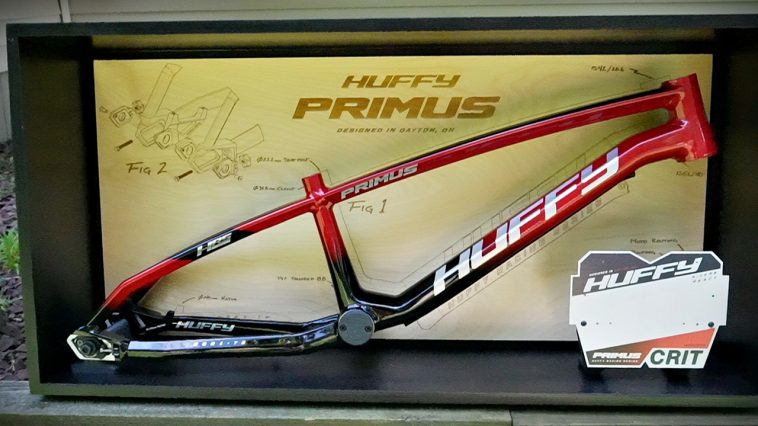
If you still think of Huffy as the company that makes basic bikes you see at the local big-box store, the new Huffy Primus BMX race frame might make you rethink that.
This isn’t a typical Huffy.
The Primus is a serious BMX racing frame with a very different design philosophy, some interesting frame technology, and enough personality to make it stand out from the crowd. After getting my hands on one, I decided there was only one way to find out what it could really do: build it up, ride it, and put it through the kind of abuse I normally give my bikes.
And yes, this Huffy was going to get ridden.
Huffy Primus: A Different Kind of Huffy
The Primus immediately grabbed my attention because Huffy didn’t simply throw together another cookie-cutter BMX racing frame.
Huffy spent 2025 prototyping and testing the bike, with the team taking it to races, trails and pump tracks and putting the frame through real-world testing.
The frame also arrived with something you don’t normally expect when buying a BMX race frame: a limited-edition display case.
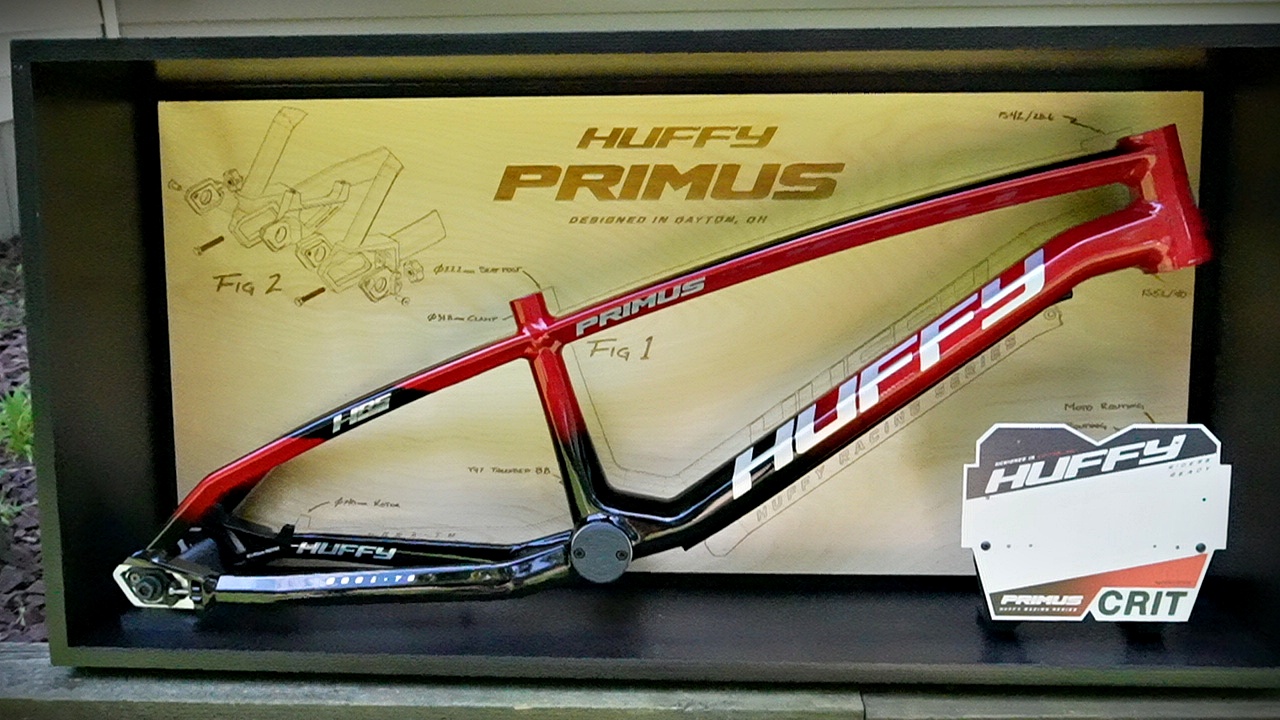
The display is designed to showcase the frame and number plate and even includes geometry information. The idea is pretty wild—you can race the bike, take it apart, and then put the frame back into the display case when you’re done.
That’s definitely not your typical BMX packaging.
But the display case is only the beginning.
The Huffy Primus Frame Has Some Interesting Design
One of the biggest things that stood out to me was the frame construction.
The Primus uses 6061-T6 aluminum and a threaded T47 bottom bracket. The larger bottom-bracket area gives the frame more material around the junctions for the chain stays, seat stays and down tube, which should help create a stiff structure.
But the feature that really caught my attention was the relationship between the seat tube and down tube.
They’re essentially one continuous piece of aluminum.
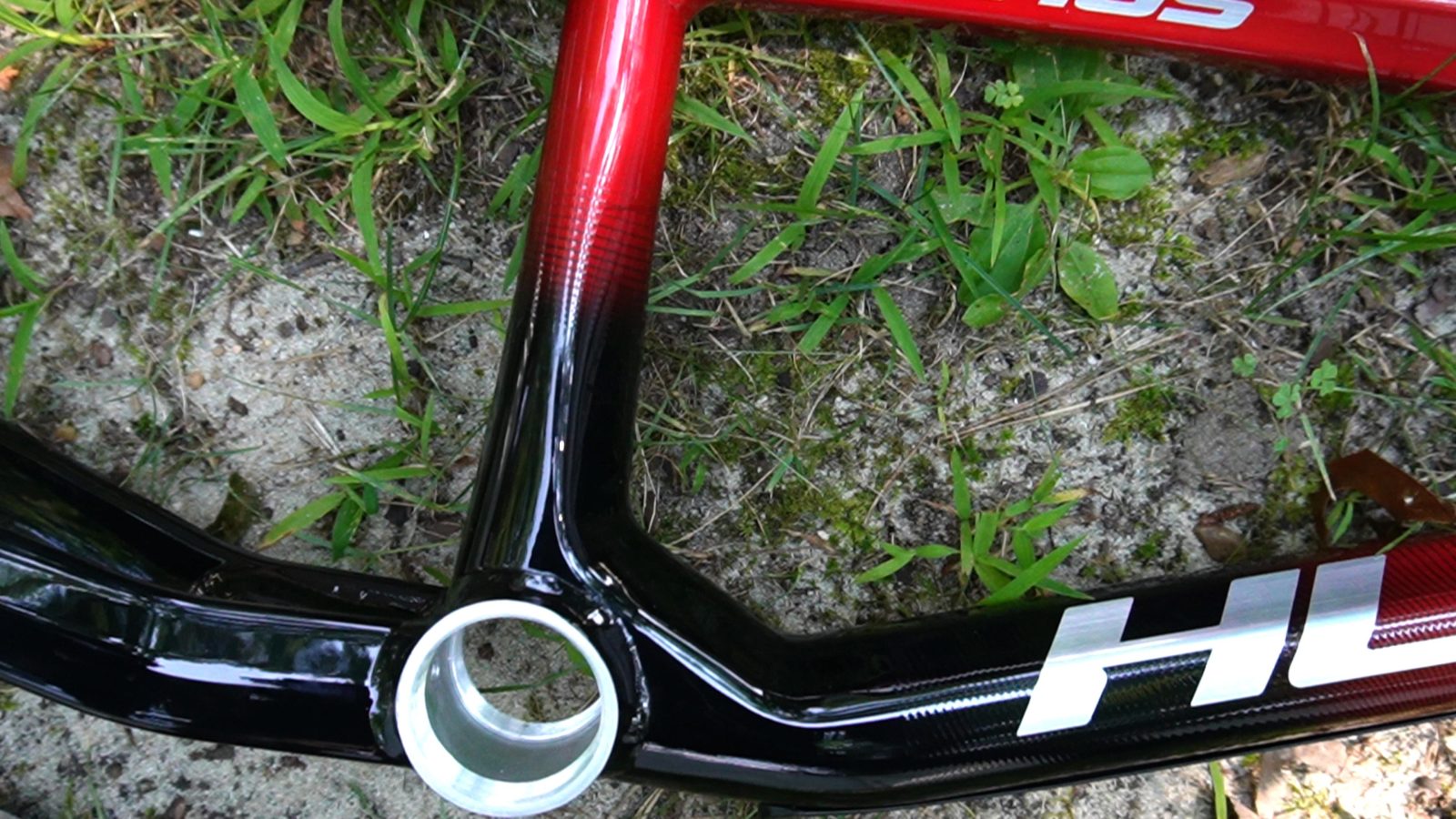
There aren’t the usual weld points where you would expect them because Huffy has incorporated the seat tube and down tube into one piece. That’s an interesting and unique approach for an aluminum BMX racing frame.
The frame also uses hydroformed tubing, a tapered head tube, a beefy top tube and shaped chain stays. The tubing isn’t just a collection of simple round tubes either; Huffy clearly put some thought into shaping the frame around strength and stiffness.
There’s even a bend in the down tube—something I personally like seeing on a BMX frame.
An Integrated Chain Tensioner
Another feature that immediately stands out is the rear dropout.
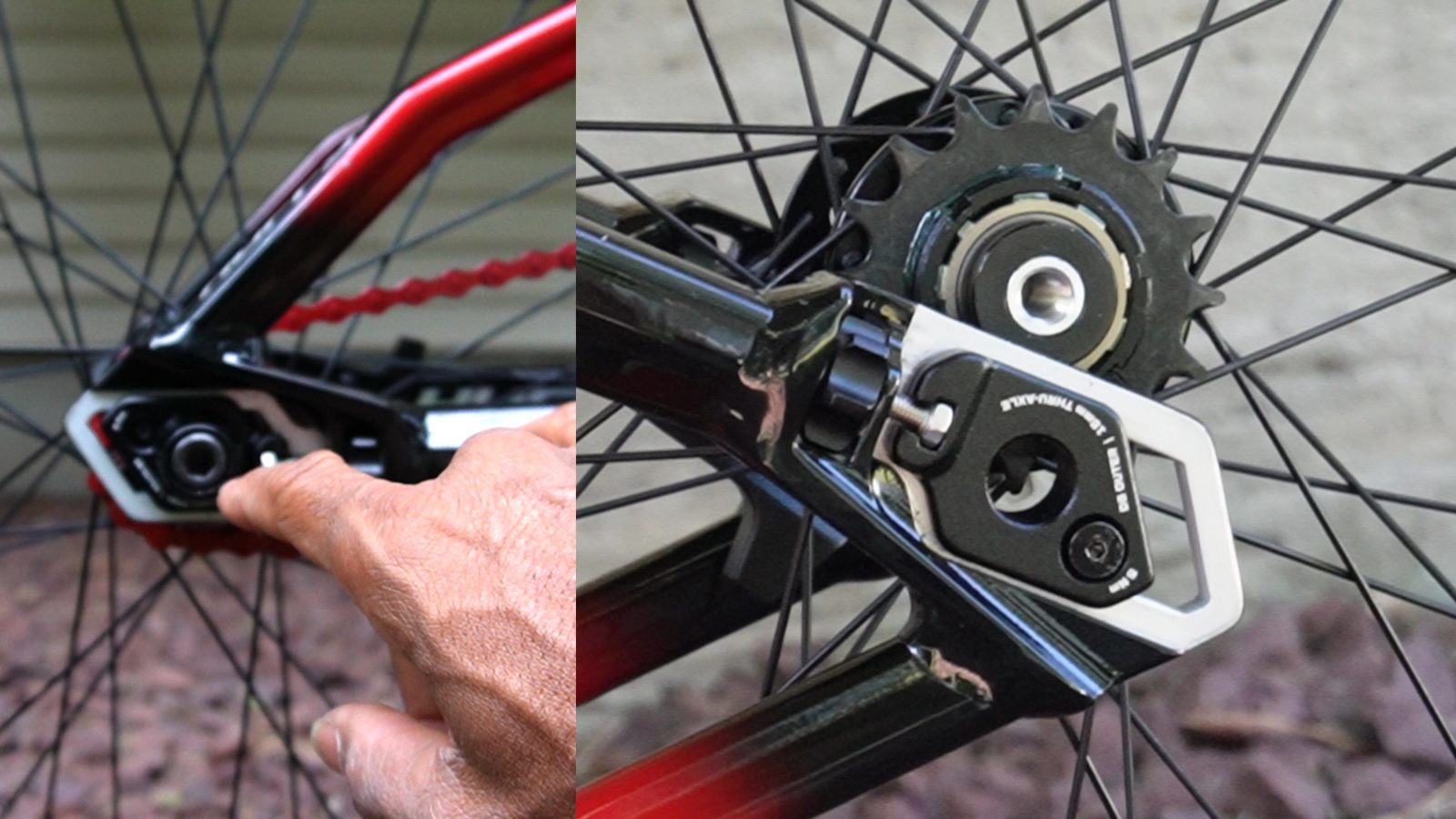
The Huffy Primus has an integrated chain tensioner with a knob that makes adjusting the rear wheel position straightforward. Instead of having to rely on separate chain-tensioning hardware, the system is built into the frame.
The dropout is enclosed, and the frame uses a 15mm thru-axle setup.
Since the Speedline Killer Buzz rear wheel being used had a smaller 10mm axle, an adapter was needed to make the wheel work with the Huffy’s 15mm dropout. The frame’s dropout system also appears designed around replaceable inserts, giving the setup some flexibility for different axle sizes.
That’s another area where the Primus doesn’t feel like a generic BMX frame.
External Cable Routing With a Cover
Here’s another interesting choice.
Instead of completely internalizing the brake cable, Huffy uses an external cable-routing system that’s covered by a protective piece.
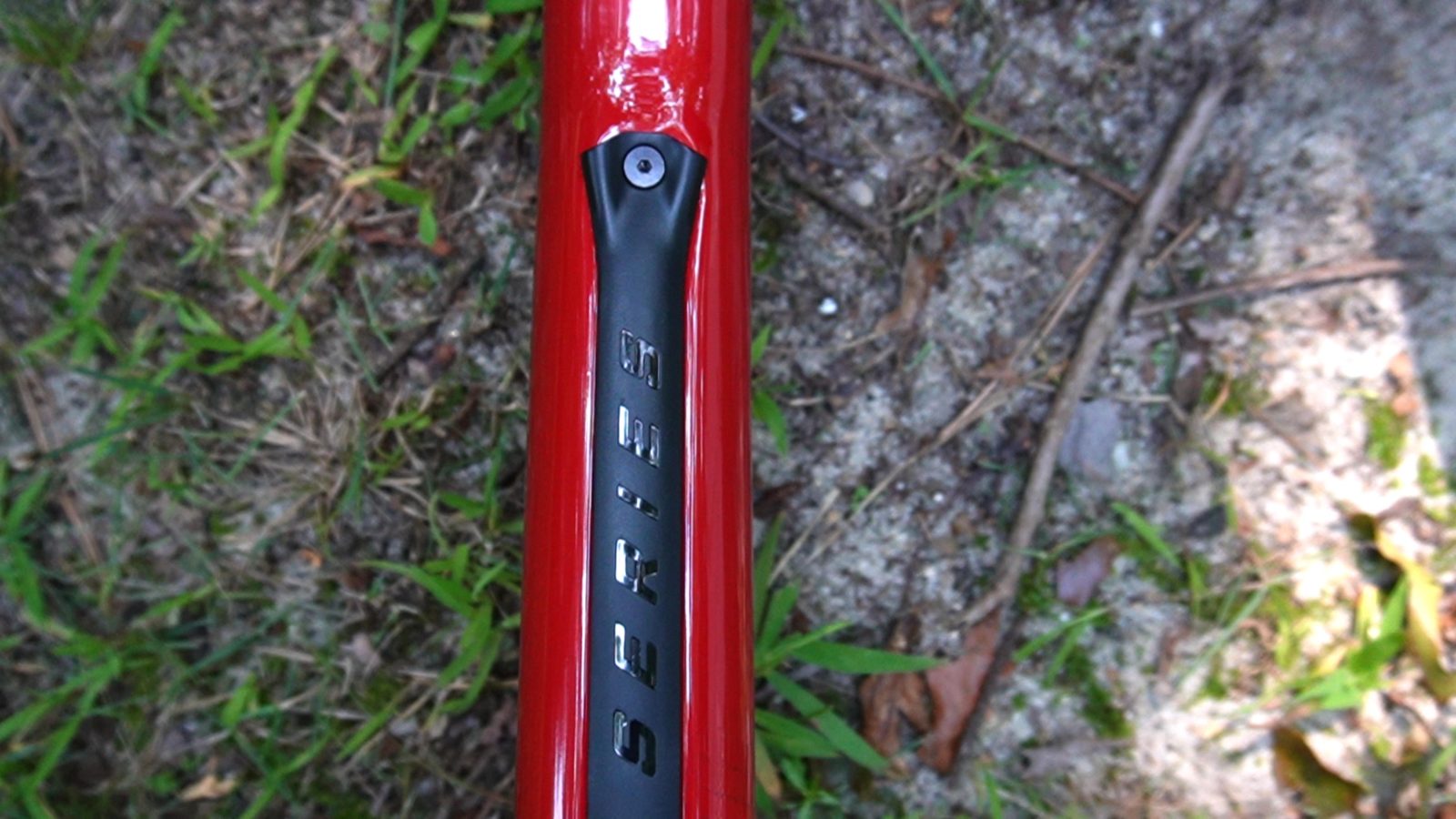
The cable runs along the underside of the down tube and the cover keeps everything contained and looking clean.
There is one little quirk I discovered while riding the bike without the brake cable installed: the cover can pop off because the brake cable normally helps hold everything in position.
That’s not really a flaw with the intended setup, though. The Primus is designed to run disc brakes, and once the cable is installed, the routing system is secured.
If I were changing anything, I’d consider adding another attachment point to make the cover more secure even when the brake cable isn’t installed.
Building the Huffy Primus
The build was a mixture of new and old parts.
The new parts included:
- Speedline Killer Buzz wheels
- Supercross tapered SLT chromoly forks
- Speedline sealed-bearing headset
- Speedline seat and seat post
- Insight pedals
- Red Elevn chainring bolts
- T47 bottom bracket
- Box Three disc brake components
The build also used several parts from my Sugar Cayne New Bridge Pro XL to keep the project within budget.
And that’s one of the advantages of having another BMX around: you don’t necessarily have to buy an entirely new collection of parts every time you build a bike.
You can move components around and create something completely different.
A Small Bottom Bracket Problem
The build wasn’t completely trouble-free.
The first bottom bracket I had wasn’t the right setup for the crank configuration. I eventually realized I needed a T47 outboard bottom bracket to get the spacing necessary for the cranks. The outboard bottom bracket is wider, stronger and smoother than an internal bottom bracket. So, I had to go to the bike shop and pick up some spacers. Shout out to Carl Hart bike shop!
That’s one of those lessons you learn during a bike build: having the correct frame standard doesn’t necessarily mean any ole bottom-bracket setup you get will work the way you want.
The bike also initially had no brakes because the hydraulic brake parts hadn’t arrived yet.
That meant the first ride had to be taken very carefully since I was going to ride around brakeless!
The First Ride: This Huffy Can Manual
Once the bike was assembled enough to ride, the first thing I wanted to know was simple:
How does it feel?
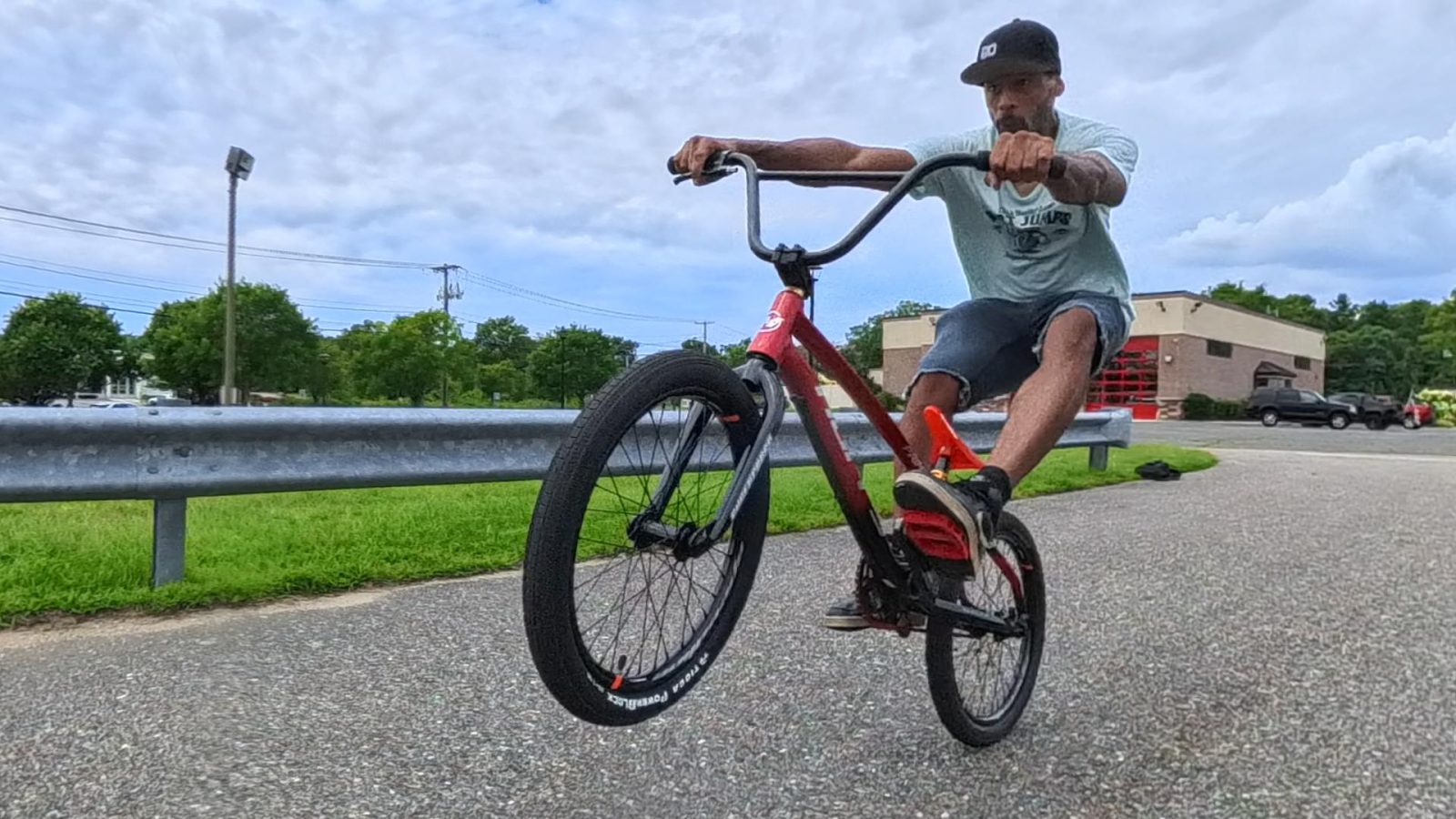
One of the first tests was the manual.
And surprisingly, the Primus felt really good at it.
The longer rear end gave the bike a larger manual sweet spot, making it easier to find and maintain the balance point. The longer rear end also provided more room for body movement and corrections.
That was one of the biggest surprises of the first ride.
The bike is long, but that doesn’t necessarily make it difficult to manual. In this case, the longer geometry actually made the bike feel stable and predictable once it was up on the rear wheel.
The more I rode it, the more comfortable the manual became.
By the end of the ride, I was able to crouch down behind the bike and make adjustments while keeping the front wheel up—even while dealing with wind.
It Isn’t Just a Race Bike
Yes, the Huffy Primus is a BMX racing frame.
But that doesn’t mean you have to treat it like it’s made of glass.
I wanted to see what would happen when I started using it for things beyond simply riding around a BMX track.
So I started playing.
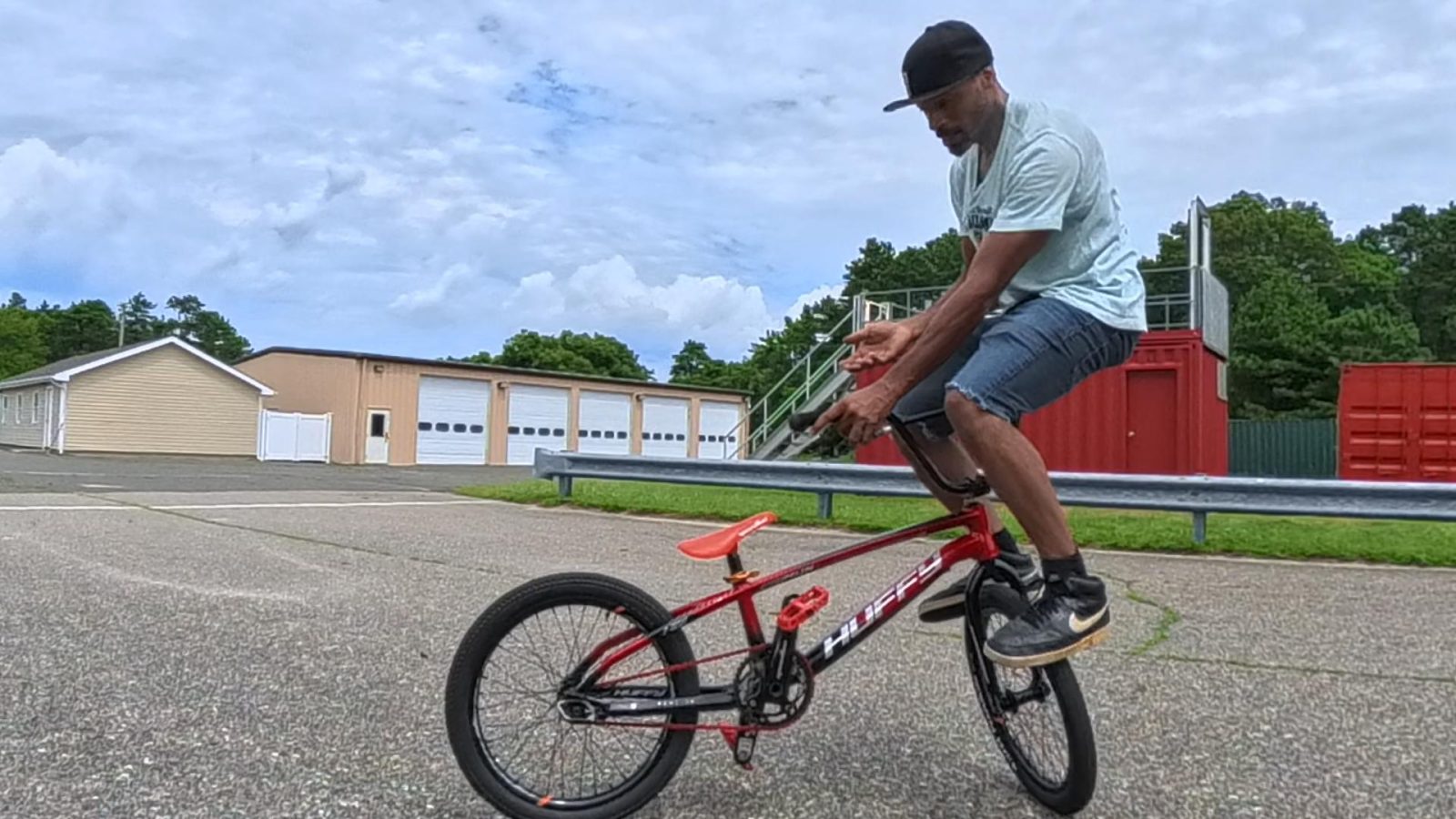
Manuals.
180s.
Endos.
Foot jams.
Bunny hops and tricks.
The Primus handled the abuse surprisingly well.
I was able to throw a 180 on the bike without much trouble, even though this is a bike designed around BMX racing and going fast in a straight line.
And that’s really the philosophy behind my entire build.
BMX is supposed to be fun.
Why I Chose Chromoly Forks
For this particular build, I chose chromoly forks instead of carbon.
That’s not necessarily because carbon is bad. It’s because of the way I ride.
I don’t just want to race this bike, I want to do bunny hops, jump curbs, commuting and other fun stuff my on BMX bike. And occasionally, things will get a little sloppy.
For that kind of riding, I wanted the additional confidence of a chromoly fork.
The goal is to make this bike something I can actually have fun with—not something that has to stay perfectly clean and only see the BMX track.
The Primus Gets Scuffed
Of course, once you start doing tricks on a race bike, something is eventually going to happen.
The Huffy Primus started getting scuffed before it even made it to the BMX track.
And honestly?
That’s kind of the point.
I wasn’t interested in building this bike just to put it in the garage and admire it.
I wanted to find out what it could do.
The bike was going to get ridden, and ridden hard.
That means scratches, dirt and whatever else comes with actually using a BMX.
The Long Wheelbase Makes It Interesting
One of the things that became increasingly obvious during the ride was how stable the Primus felt.
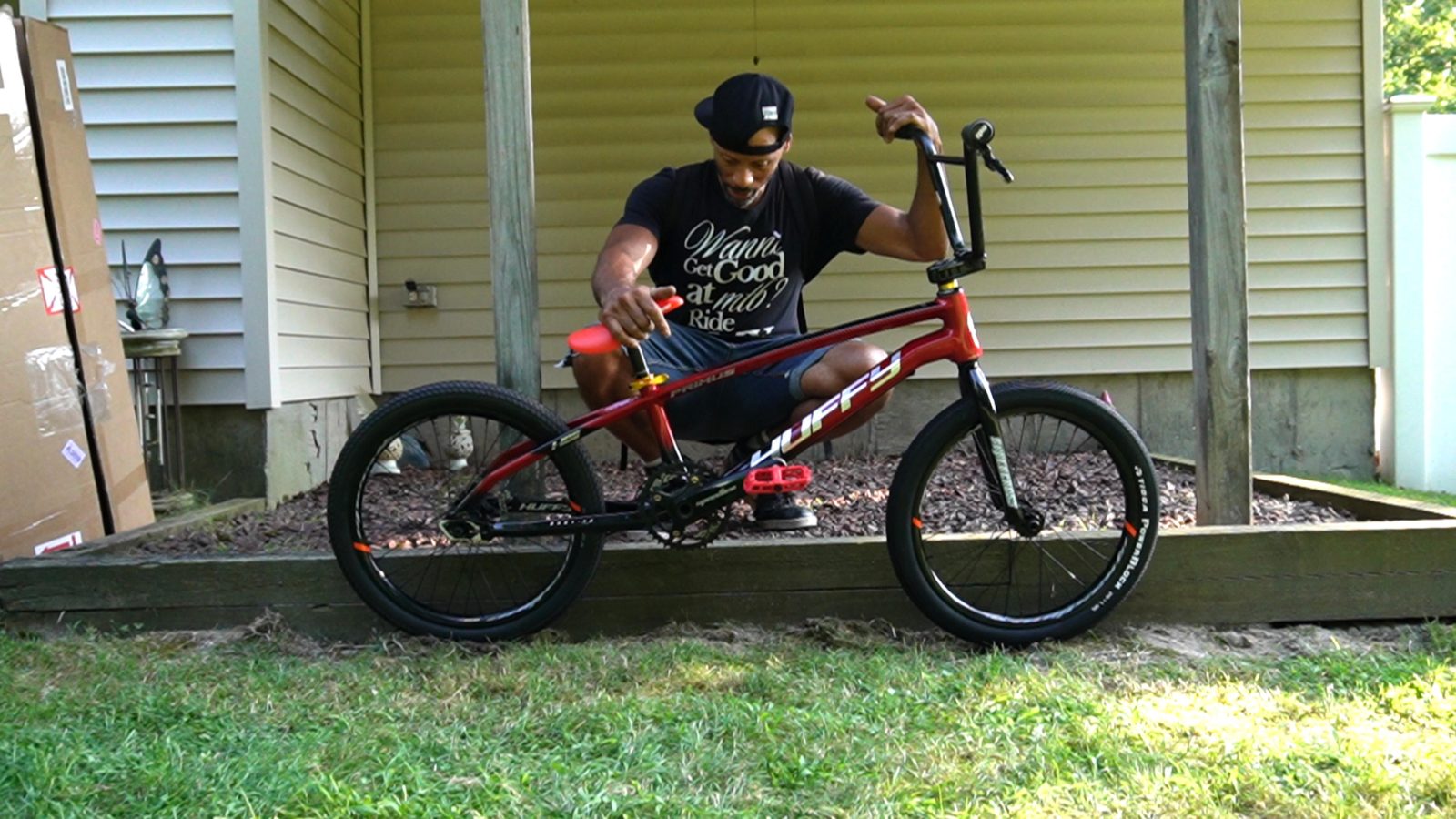
The longer wheelbase gave it a smoother feel, and the longer rear end provided plenty of room to move around when doing manuals.
That’s something I could see becoming particularly useful on longer rides as well.
The plan isn’t just to take the Primus to the BMX track.
I also want to use it for longer-distance riding and commuting.
So, Is the Huffy Primus Really a Serious BMX Race Bike?
Absolutely yes!
This isn’t the Huffy that pretty much everyone might immediately think of when they hear the name.
The Primus is a serious aluminum frame, that have modern geometry, a T47 threaded bottom bracket, integrated chain tensioning, a 15mm thru-axle setup, disc-brake compatibility and several frame-design details that make it stand apart.
And the most important part?
It rides like a serious BMX.
During the first ride, the bike felt agile, stable and capable of doing much more than simply going straight.
The frame also has some serious racing credibility behind it. Huffy’s team has been testing and racing the bike, with riders including Nick Long, Carly Kane and Ethan Popovich putting the bike to work. The bike has already taken its riders to the podium at several major BMX races
The Huffy Primus Is Bringing Back Some BMX History
There’s also a little bit of nostalgia attached to this bike.
Huffy has a history in BMX racing, and the Primus name isn’t completely new to the BMX world.
Huffy had a BMX racing team when the original Primus was around. And if you go even further back to the 80’s, Huffy was doing it big with their BMX team and BMX Legend Stu Thomsen. So this new Primus is part of a larger return to the brand’s BMX heritage.
That’s pretty cool to see.
A brand with an established BMX history is coming back into the racing scene with a modern frame instead of simply putting an old name on a basic bike.
What’s Next for the Huffy Primus?
The first ride was only the beginning.
At this point, the bike still needed the correct outboard T47 bottom bracket and hydraulic disc brakes before I can go full in.
The next step is where things get really interesting:
The trails.
The BMX track.
And eventually, some longer-distance rides.
The plan is to live with the Huffy Primus for a while and see what it can really do—not just during one first ride, but over time and in different situations.
Final Thoughts
The Huffy Primus surprised me. Because the frame has much more going on than the Huffy name might lead some people to believe.
The one-piece down tube and seat tube, T47 bottom bracket, integrated chain tensioner, enclosed dropout, external covered cable routing and modern axle setup show that Huffy wasn’t simply trying to make another BMX racing frame.
They were trying to make their own frame. And after riding it, the biggest thing I can say is this:
The Huffy Primus is fun.
It manuals well. It feels stable. It’s capable of tricks. It has a longer, smoother feel, and it has the kind of frame design that makes you want to keep riding it to find out where its limits are.
And that’s exactly what I’m going to do.
Because a BMX bike doesn’t have to stay inside the box of what somebody says it’s “supposed” to do.
Race it.
Ride it.
Jump it.
Commute on it.
Do some tricks.
Get it dirty.
Just have fun with it.
That’s what BMX is all about.